
What happened on the Lebanese border? Can you tell us about that day?
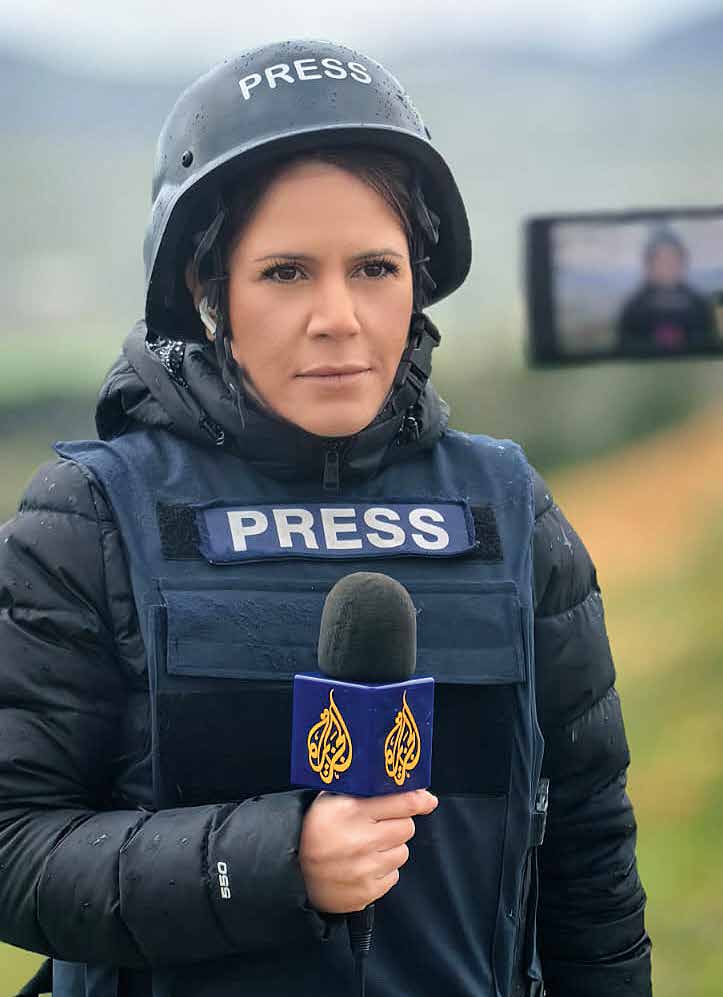
On the 13th of October? Okay, so we were the first journalists to be in the south of Lebanon, on the borders since the 7 October. And we started covering since then. We were in Marwahin on Oct. 9 when everything started after one of the Palestinian parties decided to cross the borders. And on that day, when we were covering, we were the first time… it was the first attack against us. A rocket, an Israeli rocket just fell behind us. We were the only journalists there, and nobody was there, even civilians or anybody. On the 13th of October, we were covering as usual from Alma al-Sha’ab on the borders. Actually, it’s like 2 km’s away from the borders on a hill. There was shelling. And when we reached Alma al-Sha’ab, we chose our location wisely, we can say. We chose like a hill. We are clearly seen as journalists. We were wearing our gears such as flak jackets and the helmets also. And we were covering. We did like two lives. And then we had our colleagues from Reuters and AFP joining us at 6:02 pm. Supposed to have another live at 6-6:15 almost. So, I was connected and I was speaking with Issam, my colleague. And then I had a camera test. And at 6:02, the first Israeli rocket attacked us, killing our colleague and friend, Issam Abdullah, and also another colleague got injured. And then the second rocket fell after 37 seconds. It directly targeted our car, Al Jazeera’s car, injuring everybody else, including me and the cameraman, Eli Brachia. After that second rocket, I made all the calls to tell the bureau that we’re injured, to seek help. But it was so hard because Israel, usually they mess with GPS. So, it was so hard to send our location to the Red Cross or to anybody else to seek help. And I asked them, please follow the smoke to find us.
How does it feel to lose your colleague?
It was the hardest thing in my life. He was the most joyful person ever. And seeing him, like, dying in front of your eyes and you’re just unable to do anything to save him.
Did the Israeli army do this on purpose?
What do you think? Well, actually, it’s not only me saying this. It’s Human Rights Watch, it’s Amnesty, it’s Reporters Without Borders. It’s all the investigations conducted by those organizations. It’s the letter sent by three rapporteurs, UN rapporteurs, to Israel, asking them to do an investigation because they are responsible for that attack. It’s official now that this was a deliberate attack against journalists. This is what all those organizations are saying.
How do you evaluate the censorship of events in the Western media?
Actually, I don’t feel like evaluating what’s happening in the media. But what I can say; we have brilliant journalists all over the world. They are doing brilliant work also. This is why we’re seeing demonstrations all over the world. People are marching for Gaza, for Palestine, for the south of Lebanon. And this is very important. There’s something changing because of those journalists and because of those activists also. And this is very important. Each and every one of us has a role to shed light on what’s happening in Gaza, in the West Bank also, and in the south of Lebanon as well. Because what’s happening in the south of Lebanon is also huge. It’s also scary because civilians are being targeted, civilian houses are also being hit. So, we need more voices to tell those stories. And this is what Israel doesn’t want to happen. They want to keep the narrative. They want to tell their story, their side of the story, and they don’t want another side.
Do you want to go to all these places again in the near future?
Well, I have chosen my career and path with a huge belief in human rights, with a strong belief in humanity. And I believe that those stories should be told, people’s stories should be told, and the voices of the people should never be tamed. And I believe that I made during all the path, during my career, I worked on lots and lots of stories. And I believe that I want to continue and carry on with my work. I don’t want to stop. What happened is very disturbing, it’s painful. But I will go back very professional with the ethics, with the media ethics that I believe in, that I stick to. And also, I am the one to choose what I want and what I want to do. No one is allowed to impose anything on me. And I want to carry on for myself, for my friends, those who are not able to go. And I salute every single journalist now standing on the borders or standing in Gaza. This is not an easy choice. But when you believe in humanity, you will cover wherever you go in the world, no matter the religion, no matter the race, no matter the nationality, because you believe in humanity and in human rights. And this is what matters. If you don’t do this, if you don’t believe in this, what kind of journalists are you?